miércoles, 12 de diciembre de 2012

55555, or, How to Laugh Online in Other Languages

[optional image description]

Imagine you and I are chatting somewhere and sometime on the Internet. Imagine that, in the course of our conversation, I -- and this may require some extra imagination -- say something utterly, awesomely hilarious. Something like this. Or like this. Or this. Or this. How would you respond?
You could say the obvious thing: "Megan, that is utterly, awesomely hilarious." Most likely, though, you would say something else, something that better reflects a more natural response to my hilarity. Something like "LOL." Or ":-)" Or "ha." Or, if my hilarity is a little more hilarious than usual, "haha." Or, if my hilarity is a little less hilarious than usual, "heh." Or, if I my hilarity is slightly ironic, "hehe." Or, if my hilarity is slightly impish, "teehee." Or, if my hilarity is excessively hilarious in a way that requires some excessive laughter: "hahahaha." Or "haaaaaaaaaaaahaha." Or "hahahahahahahahahahahahahahahaha." 
But, so many hahas, you get the idea: You'd find a way, basically, to convey through textual means the uncontrollable laughter I have provoked.

But: what if we weren't speaking English? What if we were chatting in Spanish, or Mandarin, or Japanese? In an amazing reddit thread this morning, redditors from non-English-speaking countries have been weighing in on a very good question: "what is internet culture like in your first language?"
And the most-upvoted answers, awesomely and tellingly, have focused on laughter. Laughter rendered in letters and numbers and characters -- laughter that transcends language but also, online, utterly relies on it.
So, how do you laugh, on the Internet, in other languages? Here -- haaaaaaaaaahahaha -- is a starting guide:

Thai: 55555
In Thai, the number 5 is pronounced "ha" -- so instead of saying "hahahahaha," Thai speakers will sometimes write "55555."

Japanese: www
This abbreviation, not to be confused (which is to say, often to be confused) with the one for the World Wide Web, likely originates with the Kanji character for "laugh," 笑, which is pronounced as "warai" in Japanese. "Warai," in message boards and chat rooms, quickly became shortened to "w" as an indication of laughter. And then, much the same way "ha" begat "haha" begat "hahaha," the sentiment became extended -- to "ww" and then "www" (and also, if you're so inclined, to "wwwwwww").

Chinese (Mandarin): 哈哈 or 呵呵
Though laughter is written 笑声 and pronounced xiào shēng, Mandarin also relies on onomatopoeia for laughter: 哈哈, pronounced hā hā, and 呵呵, pronounced he he. Similarly, xixi, 嘻嘻, suggests giggling.
Interestingly, the number 5, in Mandarin, is pronounced as "wu" -- meaning that Thai's "55555" would, in Chinese, be prounounced "wuwuwuwuwu." This is the sound equivalent, a Chinese-speaking redditor points out, of "boohoo" -- meaning that laughter in one language is crying in another. Similarly, since the number 8 is pronounced "ba," Chinese speakers sometimes use "88" to sign off, or say "ba ba" ("bye bye"). Along those lines, should you want to reward someone you're chatting with not just with laughter, but with actual praise ... 8888888888 in Japanese represents applause, since 八 (eight) is pronounced "hachi," which sounds like "pachi pachi," which is onomatopoeia for clapping.

Korean: kkkkk or kekekekeke
This comes from ㅋㅋㅋ, short for 크크크, or keu keu keu -- the Korean equivalent of the English "hahaha."

French: hahaha, héhéhé, hihihi, hohoho; also MDR
French uses onomatopoeic laughter variations much like those in English. It also, like many non-English languages, uses the universalized "LOL" to indicate laugher. But French also has a more delightful acronym: The French equivelant of LOL is MDR, which means "mort de rire," or "dying of laughter."

Spanish: jajaja
In spanish, j is pronounced like the English h, so "jajaja" is the direct analog of the English "hahaha."

Greek: xaxaxa
Same deal.

Hebrew: xà xà xà or חָה־חָה־חָה
Same.

Brazilian Portuguese: huehuehue, rsrsrsrsSame, with the vowels varying rather than the consonants.

Danish: ha ha, hi hi, hæ hæ, ho ho, ti hi
Same deal.

Icelandic: haha, hehe, híhí
Same.

Russian: haha хаха, hihi хихи, hèhè хехе
Same.

Sauce: http://www.theatlantic.com/technology/archive/2012/12/55555-or-how-to-laugh-online-in-other-languages/266175/

viernes, 16 de noviembre de 2012

Can We Link Hurricane Sandy to Climate Change?


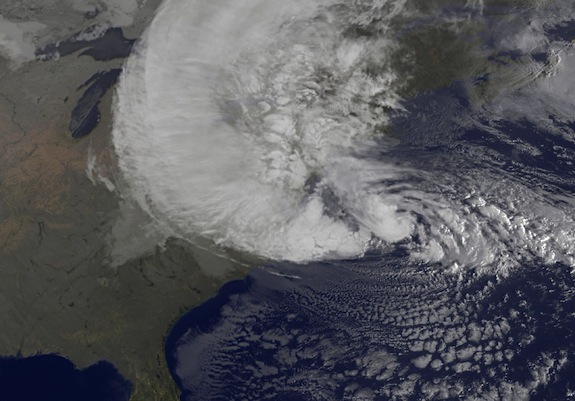
Models indicate that climate change will cause more frequent hurricanes, but the overall trend can’t be linked with a particular event, such as Hurricane Sandy (above, on October 29). Image via NASA
Hurricane Sandy has collided with a cold front to form a “Frankenstorm,” bringing extreme weather to the East Coast. Experts predict that the storm will cause billions of dollars in damages and couldcause as many as 10 million people to lose power. This historically unprecedented weather event brings to mind a troubling question: Is the storm a natural occurrence or a consequence of human-driven climate change?
The answer—as often happens in science—is more complicated than a simple yes or no. For starters, there’s the distinction between weather and climate. As my colleague Sarah Zielinski wrote here in 2009, “Weather is a data point. Climate is a collection of data.” Science tells us that increasing concentrations of greenhouse gases will doubtlessly change the climate, but linking that overall shift to any one weather event is far less certain.
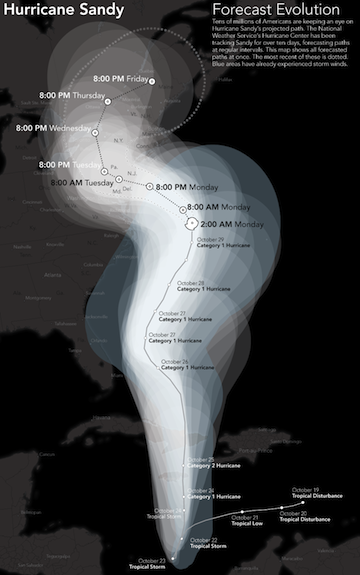
Sandy is likely to bring unprecedented damage to the East Coast. Image via the National Weather Service.
Nevertheless, climate models do predict that on the whole, cyclones (a category that includes hurricanes, typhoons and other extreme storms, named depending on their location) will become more frequent and intense as the climate changes. The reason is that, as noted in a 2010 Nature Geoscience study, warmer oceans cause more evaporation and precipitation, theoretically leading to more frequent powerful storms like Sandy.
As Bill McKibben writes at The Daily Beast, “when that ocean is hot—and at the moment sea surface temperatures off the Northeast are five degrees higher than normal—a storm like Sandy can lurch north longer and stronger, drawing huge quantities of moisture into its clouds, and then dumping them ashore.” A study published earlier this month in Proceedings of the National Academy of Sciences found a strong positive association between warmer years and storm activity in the 20th century, while the Nature Geoscience study noted that the latest models indicate that by 2100, tropical cyclones (including hurricanes) will occur 6 to 34 percent more frequently.
However, it’s important to note that these predictions are made with less confidence than many others dealing with the climate’s future. As Adam Frank writes at NPR, these types of long-term climate forecasts are arranged in a confidence hierarchy. Climate models allow us to be most certain, for example, that global average temperatures will increase and extreme heat events will become more frequent.
The amount of confidence that can be assigned to the prediction of increased cyclones and hurricanes over time is lower. As an IPCC special report on extreme weather events notes, “There is low confidence in any observed long-term (i.e., 40 years or more) increases in tropical cyclone activity (i.e., intensity, frequency, duration), after accounting for past changes in observing capabilities.”
The reason for this reduced amount of confidence is partly the fact that storm formation is far more complicated than the simpler physics of greenhouse gases trapping radiation and causing overall warming. Additionally, since cyclones occur irregularly—and there is limited historical data on their frequency and magnitude prior to the satellite era—the degree to which their formation can be linked to climate change is restricted.
As Andrew Revkin points out at the New York Times’ Dot Earth blog, the overall scientific picture is simply more complex than advocates for action on climate change might prefer. He cites a2002 Nature study [PDF] that notes:
Climate models suggest that human activities, specifically the emission of atmospheric greenhouse gases, may lead to increases in the frequency of severe storms in certain regions of the Northern Hemisphere. However, the existence of natural variability in storminess confounds reliable detection of anthropogenic effects.
Put most bluntly, this storm will bring terrible consequences to millions of East Coast residents, and we have many compelling reasons to limit anthropogenic climate change to whatever degree possible before it’s too late. But it’s scientifically disingenuous—even for those of us who are most desperate to convince others of the seriousness of the threat—to explicitly link this one weather event to the overall experiment we’re conducting on the planet’s atmosphere.

Source: http://blogs.smithsonianmag.com/science/2012/10/can-we-link-hurricane-sandy-to-climate-change/

In Experiments, Caffeine Accelerates the Brain’s Verbal Processing


A new study shows that the equivalent of a few cups of coffee can help us process words more quickly and accurately. Image via Flickr user Jennie Faber

A cup or two of coffee doesn’t just give you energy—it might make you a think a little more quickly. That’s not exactly a shocker, but for coffee drinkers, a new study showing that caffeine can improve verbal processing speed should put a nice perk in your day.
Despite conventional wisdom that caffeine is a harmful drug, a growing body of research is demonstrating that it can confer a wide range of benefits when consumed in moderation. Within the past year, studies have indicated that caffeine can help improve muscle strength for seniors, delay the onset of Alzheimer’s and reduce the risk of skin cancer.
Now, a study published today in the journal PLOS ONE suggests that 200 mg of caffeine—the equivalent of a couple of cups of coffee—can help the brain identify words more quickly and precisely. In a study conducted by psychologists Lars Kuchinke and Vanessa Lux from Ruhr University in Germany, healthy young adults given a 200 mg caffeine tablet exhibited improved speed and accuracy while completing a word recognition task.
The task involved looking at a string of letters, presented one at a time for 150 milliseconds each, and deciding as quickly as possible whether they constituted an actual word or a made up word. When compared to a control group that was given a placebo (a lactose tablet), those given the caffeine pill decided more quickly and were correct a higher percentage of the time—at least for words that were deemed to have a positive emotional association.
Why only for positive words? The researchers designed the experiment not to demonstrate benefits of caffeine, but in order to use the drug to answer an existing question about the underlying architecture of the brain. It has long mystified cognitive scientists why, when completing these types of word processing tasks, people consistently demonstrate a quicker response time for words with a positive emotional valence (like “love” or “happy”) than those with a negative connotation (like “bored” or “angry”).
Kuckinke and Lux, recognizing that caffeine stimulates the release of the neurotransmitter dopamine, decided to use the drug to test a hypothesis, to see if dosing study participants would further increase their speed and accuracy for positive words.  The caffeine did indeed make them even better at completing the task for positive words—but not for negative or neutral ones—leading the researchers to conclude the involvement of the dopamine system is at least part of the explanation for the phenomenon.
Additionally, the researchers zeroed in on the region of the brain responsible for the effect. When they showed the study participants the letters, they did so directly in front of either their left or right eyes, flashing them so quickly that only the half of the brain directly wired to the particular eye would have time to process them. Because the brain is cross-wired—so the right half of the field of vision is most immediately connected with the left hemisphere—and the accelerated processing effect was only for letters shown in front of the participants’ right eyes, it seems to be rooted in the language-dominated left hemisphere.
Scientists still have many questions about this effect, and this pair notes the need for further study to understand how it is involved with the dopamine system, frequently associated with reward centers in the brain.
On a more practical level? You might consider applying these current findings by drinking a cup of coffee when your thought processes seem a little slow.

Source: http://blogs.smithsonianmag.com/science/2012/11/in-experiments-caffeine-accelerates-the-brains-verbal-processing/

Buddhism


Buddhism is a religion indigenous to the Indian subcontinent that encompasses a variety of traditions, beliefs, and practices largely based on teachings attributed to Siddhartha Gautama, who is commonly known as the Buddha (meaning "the awakened one" in Sanskritand Pāli). The Buddha lived and taught in the eastern part of the Indian subcontinent some time between the 6th and 4th centuries BCE. He is recognized by Buddhists as an awakened or enlightened teacher who shared his insights to help sentient beings end suffering (dukkha) through eliminating ignorance (avidyā) by way of understanding and seeing dependent origination (pratītyasamutpāda) and eliminating craving (taṇhā), and thus attain the highest happiness, nirvāņa (nirvana).

Two major branches of Buddhism are recognized: Theravada ("The School of the Elders") and Mahayana ("The Great Vehicle"). Theravada has a widespread following in Sri Lanka and Southeast Asia. Mahayana is found throughout East Asia and includes the traditions of Pure Land, Zen, Nichiren Buddhism, Tibetan Buddhism, Shingon, and Tiantai (Tendai). In some classifications, Vajrayana—practiced mainly in Tibet and Mongolia, and adjacent parts of China and Russia—is recognized as a third branch, while others classify it as a part of Mahayana. There are other categorisations of these three Vehicles or Yanas.

While Buddhism remains most popular within Asia, both branches are now found throughout the world. Estimates of Buddhists worldwide vary significantly depending on the way Buddhist adherence is defined. Lower estimates are between 350–500 million.

Buddhist schools vary on the exact nature of the path to liberation, the importance and canonicity of various teachings and scriptures, and especially their respective practices. Two of the most important teachings are dependent origination and no-self. The foundations of Buddhist tradition and practice are the Three Jewels: the Buddha, the Dharma (the teachings), and the Sangha (the community). Taking "refuge in the triple gem" has traditionally been a declaration and commitment to being on the Buddhist path and in general distinguishes a Buddhist from a non-Buddhist.Other practices may include following ethical precepts; support of the monastic community; renouncing conventional living and becoming a monastic; the development of mindfulness and practice of meditation; cultivation of higher wisdom and discernment; study of scriptures; devotional practices; ceremonies; and in the Mahayana tradition, invocation of buddhas and bodhisattvas.

Source: http://en.wikipedia.org/wiki/Buddhism

martes, 13 de noviembre de 2012

Neil Finn Reaches Epic Heights on 'Song of the Lonely Mountain' – Song Premiere


Click to listen to Neil Finn's 'Song of the Lonely Mountain'

Peter Jackson's The Hobbit: An Unexpected Journey is fast approaching, and the epic adventure movie gets an appropriately epic ballad with Neil Finn's "Song of the Lonely Mountain." With angelic vocals, swooning strings and a slow, determined build, the tune captures the feel of an arduous trek across a rocky, perilous landscape. Metal crashes invoke blacksmiths hard at work forging weapons in the fire while the classical guitar floats between the chants and clattering percussion.
"'The Song of the Lonely Mountain' was developed from a dark and mysterious theme which the dwarves sing early in the movie," Finn tells Rolling Stone. He says Jackson and his team suggested he get in a "dwarven state of mind" as he shaped the song to play over the end credits. "After some days of mining underground (actually, in Peters office) I emerged with the song, then set about recording it with my sons Elroy and Liam. Dave Fridmann came in at the end with a bold mix. He seemed to respond well to my demands for 'more anvil!' Pop music needs more anvil!"
The soundtrack for The Hobbit: An Unexpected Journey will be out on December 11th. The film, part one in a trilogy, opens December 14th. You can pre-order the song here.


Read more: http://www.rollingstone.com/music/news/neil-finn-reaches-epic-heights-on-song-of-the-lonely-mountain-song-premiere-20121112#ixzz2C6heLxPb

sábado, 10 de noviembre de 2012

Behind the scenes of The Hobbit


There's a passage about half way through The Lord of the Rings where an orc called Ugluk forces captured hobbits Merry and Pippin to drink a hot beverage called "orc-draught".
Pippin "felt a hot fierce glow flow through him. The pain in his legs and ankles vanished".
J R R Tolkien could almost be describing coffee. And on a cold morning in 2012, on the set of The Hobbit, it's coffee that orcs prefer for a pick-me-up.
I witness two orcs, cups in hand, standing next to a tiny coffee cart between the sound stages of Sir Peter Jackson's studios in Wellington.
As in Jackson's The Lord of the Rings, these orcs wear fighting regalia.
Their makeup and prosthetics look unfinished – in The Hobbit, orc faces are transformed by computer-generated visual effects – but they still look menacing. Not a breed you can calmly approach and ask if they prefer espresso to a flat white or latte.
But seeing orcs outside of Middle-earth – and dwarfs in full prosthetics lining up for lunch in a large marquee close by – are just some of the many double takes that occur while spending two days watching filming on the US$500 million production.
Rather than ruin the surprise or extinguish the magic, seeing Tolkien's characters line up in the catering tent to plonk fish cakes, kumara mash and Chinese cabbage on their lunch plates – followed by stewed tamarillos, icecream and coconut balls for dessert – has its own special magic.
The studio hype isn't needed. The small media contingent is quickly convinced they are seeing something big.
For one, Jackson's studio setup in Wellington to make The Hobbit is considerably bigger than it was for The Lord of the Rings.
Early in 2003, I watched Jackson direct a short scene with Merry and Pippin next to part of the body of an oliphaunt, the giant elephants from the climactic battle in The Return of the King.
But even with the money then pouring in from the first two Lord of the Rings films, for most interior filming Jackson relied on one sound stage converted from a former paint factory.
That sound stage, now known as "A Stage" is still there, but it's dwarfed by the purpose-built "K Stage" nearby – built for 2005's King Kong and used for Avatar – and two more, G and F stages, built specifically for The Hobbit.
There are also several other smaller sound stages and seven "block" buildings for specific departments, including the art department, costumes, hair and makeup.
Many people are walking or running about, some with frantic expressions. Some would have been at high school when The Lord of the Rings trilogy was released.
A plethora of "trailers" – caravans and motorhomes behind A Stage – gives the aura of a Hollywood studio. Or at least how Hollywood studios are depicted in Hollywood movies.
Jackson's Wellywood equivalent is now even big enough to boast "a back lot" near the cafeteria tent, where there's a giant green screen used for outdoor visual effects filming.
But the purpose-built sound stages are tiny in comparison to another stage, albeit a temporary one, in Upper Hutt. For the first time, Jackson has used what was a long-empty former car assembly plant.
The building has so much space it can hold several large sets at the same time, or, as was the case before we visited, be used for one giant set.
The first peek we get of shooting is in Wellington at the civilised hour – by film industry standards – of mid morning.
"Today we're using all 10 orcs, so we'll need 10 orc masks" says a crew member into a walkie-talkie, as we're led to one of the converted stages. Outside A and B Stage, a collection of Middle-earth armour is draped on mannequins.
Inside, Englishman Andy Serkis, best known as the voice and motion capture model for Gollum in The Lord of the Rings, is seated in his own director's chair.
He has a small crew and a few cast members. Serkis, at Jackson's invitation, is the second unit director for The Hobbit as well as reprising Gollum. The second unit is into its 184th day of shooting.
"This is my second home, I now realise," Serkis says, of Wellington. "I love coming back here. We started shooting in March last year. Pete [Jackson] decided that he wanted to shoot the Gollum scenes first, so for the first two weeks that's what we did. I think I can safely say I was the first person in the makeup chair on The Hobbit."
Serkis became a household name playing Gollum and it's something he remains very conscious of. "Gollum's never really left me, and he's always been lurking under my skin and there's always been the possibility of returning to him.
"But to actually finally get back to do it – a very strange thing kind of happened, really. Over the years, Gollum's become so – sort of – owned by the public, and in the public domain he has become such a well known character.
To re-possess him, I suppose, was to grab him back and say, 'Right, I've got to get back inside the mindset and really play this character rather than doing a pale imitation of a hundred other persons' imitations of what I did originally'."
As to directing, he relished the opportunity. "A lot of second units are directed by stunt co-ordinators, or second unit directors only deal with a lot of background. But this is really like a whole other unit which deals with drama and all manner of things.
"Pete wanted me to do it to be his eyes and ears [and] have his sensibilities. We have had a very easy relationship with each other. It's been a huge learning curve for me, because normally for a director's first film you're shooting for maybe five or six weeks on a very low budget with a digital camera, or you're doing something contained and small, not working on the biggest film on the planet. It's literally like just passing a driving test and then being given a Ferrari. Or not even having passed a driving test and being given a Ferrari."
Serkis returns to filming and we watch some of the results on large monitors, which is common on big budget films. The big difference this time from The Lord of the Rings is that we don 3-D glasses and watch live in 3-D.
A short walk away and up some stairs is associate costume designer Bob Buck, who shows us examples of costumes for the dwarfs, elves and hobbits.
To one side are several fat suits for some of the 13 actors who play the leading dwarfs in the films.
In another corner are the clothes worn by Martin Freeman as Bilbo the hobbit.
One set is in good condition – Buck says this is before Bilbo sets out on his journey – while the rest look progressively worn and dirty the further Bilbo ventures from Hobbiton.
All up they made between 10 and 15 Bilbo jackets. Buck points to the detail. Each button on Bilbo's jacket features an acorn. Then there's each jacket reproduced again for a smaller scale double of the hobbit for some scenes.
Buck has so many mesmerising anecdotes and facts behind the costumes. The fat suit for Bombur, portly even by dwarf standards, was so convoluted it took a week just to make the stomach.
Kiwi actor Stephen Hunter, who plays him, has an 86-centimetre waist. All the fat suits can be used in tandem with a hidden cooling vest which uses tubes of water.
One floor down, the wigs and prosthetics department is equally engrossing. The walls are covered in photographs of the main actors in The Hobbit, to help with each time they sit in a chair for makeup, prosthetics and hair. Wigs in all cuts and sizes line several shelves.
Again, a lot has changed since The Lord of the Rings, when they used silicon prosthetics on the likes of John Rhys-Davies as Gimili the dwarf, says prosthetics supervisor Tami Lane.
She picks up a giant hairy rubber arm. The arm, while designed like a glove to fit over an actor's own arm, looks so real it takes a few minutes to accept it as a prosthetic. It's the same with hobbit legs. No more finicky adjustments of big hairy feet.
"We're using a product called Plat Gel, and it's pretty amazing stuff. It's a lot easier to work with, it's much more durable than what it was, because John Rhys-Davies, he wore a silicon face with gelatin eye bags. By the middle of the day, we always had to replace the eye bags because of the heat.
The body heat would just melt it away and expose the silicon underneath. So these are actually waterproof, sweatproof, heatproof, everything-proof, basically. Fireproof. And they look fantastic on."
Makeup and hair designer Peter King, whose film credits include Pirates of the Carribean: On Stranger Tides, says on The Lord of the Rings he used a lot of synthetic wigs. This time they use real hair.
"For every character, there are at least three wigs. There will be the actor's wig, there would be a scale wig, whether he has to have a large scale or a small scale [double]. There's always going to be a stunt [double], and then some had a fourth wig, which is a riding double. But when we get down to the dwarfs I think we made six wigs and eight beards for each character. They all had to look exactly the same," King laughs.
"They said, 'Come and do The Hobbit, it's much smaller than Lord of the Rings'. It's actually about five times larger than Lord of the Rings." Like everything to do with this production, the devil is in the detail. At Weta Workshop, Sir Richard Taylor proudly displays on a boardroom table a variety of weapons it has manufactured for The Hobbit. They look deadly.
"We have looked for new ways to stay on top of our game and ahead of the market where we can, and we've consistently turned more and more towards robotic-built technology in the form of laser cutters, 3-D printers, and robotic milling machines. And we now have seven robotic milling pieces of equipment working on the shop floor for us. Only one of them is actually shop-bought."
Next door at Weta Digital, which creates the computer-generated onscreen wizardry, visual effects supervisor Matt Aitken is equally proud of their achievements. "The Hobbit has many challenges, great challenges. The sort of challenges we love to work on."
Jackson's contentious decision to have the films shot at 48 frames per second rather than the standard 24 frames has been relatively straight forward, he says. "Essentially it just means that we do twice as much work. But apart from that, no, nothing changes. In fact, it's a much lower impact on us than the move from 2-D to 3-D."
Sir Ian McKellen, who reprises his role as Gandalf the wizard, isn't filming, so is out of costume but on set. Our makeshift meeting place for McKellen is a chilly trailer. He looks cold when he enters and I hand him a throw blanket. He promptly wears it like a wizard's cloak.
Of the differences between The Hobbit and The Lord of the Rings, McKellen says: "Well, a lot of it's the same and some things are a bit different." For one, The Hobbit is lighter in tone. "You can tell it's lighter, and the casting – Martin Freeman is a brilliant comic actor. Barry Humphries, Billy Connolly – wonderful standup comedians. Stephen Fry, whose stock-in-trade is laughter. And that's infected all of them. And all of the dwarfs, a lot of them had a comical background. So there's a difference in style. But in texture and in the details of costume and makeup, no, it's all the same for me."
McKellen says one reason he agreed to reprise the role was working with the same people. His praise for New Zealand goes beyond politeness and feels genuine.
"For people living so far from home, it's wonderful to feel that these are real friends. Family is probably the word. And when the family is led by a married couple [Jackson and partner Fran Walsh], part of the time I feel like their child, and part of the time I feel like [I'm] their uncle dropping by." We catch up with Jackson shooting a scene with dwarfs at the Upper Hutt sound stage. The interior is huge. There are trailers and a wind machine. To our left a set appears to be the remains of Mirkwood forest. Jackson has a pair of 3-D glasses around his neck and sips a hot drink. "I was always resistant to doing The Hobbit for a long time. I was superstitious, I just didn't think we would want to repeat The Lord of the Rings. I didn't really want to feel like I was competing with myself," he says.
It's easy to forget that Jackson's original plan was to produce The Hobbit and let Mexican film-maker Guillermo del Toro direct. But due to delays, del Toro quit and Jackson stepped in. "But since I ended up doing it, I'm having a blast. I'm really enjoying it. I'm enjoying myself probably more than The Lord of the Rings, in some respect. Because I sort of feel like I know what I am doing a lot more than I did back 12 years ago."
So, too, are the dwarfs. We meet several in costume and makeup, and out. Oin – Kiwi actor John Callen – gives an unscheduled preview by wandering into the Upper Hutt cafeteria in full costume and makeup. He spots the media and walks over. While still in character, he gently ribs us about entering Middle-earth.
Later in the cafeteria we also meet Freeman, the hobbit of The Hobbit. Freeman has a day off from filming and is in a relaxed mood and keen to talk.
In fact, he talks for nearly an hour, which surprises his handlers. Prior to being cast in The Hobbit, he was best known for television shows The Office and Sherlock. While he does get recognised on the street in Britain, he's keenly aware of the potential for much greater exposure once the first of the three Hobbit films is released next month.
"I've had 10 years of people coming up to me ... and sometimes it's great and sometimes it's not. But I can go to Italy and no-one cares, and that will change after December. So that's a big thing to consider, as well. That's a big part of the sacrifice, 'cause once that's gone ... I value being able to go into a record shop and people leaving me alone. So I really had to want to do this, and I did want to."
Kiwis garnered a reputation during the filming of The Lord of the Rings for largely leaving the actors alone when they were out in public. I ask Freeman if that's been the case in Wellington. "No, that is self-mythologising bull, I'm afraid. Kiwis don't leave you alone," he says.
'Oh, yeah, you'll love it here 'cause no one will say a thing to you.' "I went to see Rhys Darby [perform] and this guy was like, 'Can I take a picture with you?' 'Yeah, yeah, sure.' 'Can my daughter take a picture with you?' 'Yeah, yeah, sure.' 'Can we get an autograph?' 'Yeah, yeah, sure.' 'It must be nice everyone leaving you alone.' 'What do you think you're doing?' So it's this Orwellian double-think thing. We leave you alone – while we're insisting on giving you shots of tequila."
THE HOBBIT: An Unexpected Journey has its world premiere in Wellington on November 28 and opens on December 12.
- © Fairfax NZ News

Source: http://www.stuff.co.nz/entertainment/film/7932722/Behind-the-scenes-of-The-Hobbit

jueves, 8 de noviembre de 2012

Captain Britain


The character was initially intended to be a British equivalent of Captain America. Endowed with extraordinary powers by thelegendary magician Merlyn and his daughter Roma, Captain Britain was assigned to uphold the laws of Britain.


Fictional character biography

Born and raised in the small town of Maldon, Essex and educated at Fettes College in Edinburgh, Brian was a shy and studious youth, living a relatively quiet life and spending a lot of time with his parents and siblings (older brother Jamie and fraternal twin Elizabeth). The family were an aristocratic one who were no longer rich enough to fraternise with their former academic peers, leaving Brian (too proud to fraternise with lower classes) a lonely child who immersed himself in the study of physics.
After the death of his parents (Sir James and Lady Elizabeth) in what seemed to be a laboratory accident, Brian takes a fellowship at Darkmoor nuclear research centre. When the facility is attacked by the technological criminal Joshua Stragg (alias "The Reaver"), Brian tries to find help by escaping on his motorcycle. Although he crashes his bike in a nearly fatal accident, Merlyn and his daughter, the Omniversal Guardian,Roma appear to the badly injured Brian. They give him the chance to be the superhero Captain Britain. He is offered a choice: the Amulet of Right or the Sword of Might. Considering himself to be no warrior and unsuited for the challenge, he rejects the Sword and chooses the Amulet. This choice transforms Brian Braddock into Captain Britain.

Powers and abilities

Originally, Captain Britain's powers were linked to the mystical Amulet of Right, worn around his neck. When Brian Braddock rubbed the amulet he was transformed from an ordinary mortal into a superhero version of himself, complete with a more muscular physique. The amulet could also mystically replenish his superhuman energies. He also possessed a telescoping staff to vault. This also had other functions, the most heavily relied upon being the ability to project a force field. Later, Merlyn changed the staff into the mace-like Star Sceptre, which he could utilize like a quarterstaff and which also gave him the ability of flight. Merlyn changed his costume just before he entered the alternate Earth-238, fusing the powers of the Amulet and the Scepter into the new uniform and then later put these powers within Brian himself when he was forced to rebuild Brian following Brian's death at the hands of the Fury, making the suit a regulatory device for his powers. Eventually, Brian no longer required even the battle-suit for the full use of his powers, as his heritage of being the son of a denizen of the extra-dimensional Otherworld became enough to power him.
Brian Braddock has superhuman strength, speed, stamina, durability, reflexes, senses, and the ability to fly at supersonic speeds. He also possesses enhanced perceptions that allow him to be aware of things others may miss (such as objects cloaked by spells of illusion). When he and Meggan destroyed the Otherworld energy matrix at Roma's prompting, the energies that allowed him to retain his power within the UK without his costume were dissipated. Hence, to retain his powers anywhere on Earth, he must wear the costume at all times. His costume acts as an antenna and battery, allowing him to retain his powers wherever he goes.