domingo, 30 de diciembre de 2012

The Scientific Reason Why Reindeer Have Red Noses Read


Some reindeer really do have red noses, a result of densely packed blood vessels near the skin’s surface. Image courtesy of Kia Krarup Hansen
In 1939, illustrator and children’s book author Robert May created Rudolph the Red-Nosed Reindeer. The character was an instant hit—2.5 million copies of May’s booklet were circulated within a year—and in the coming decades, Rudolph’s song and stop-motion TV special cemented him in the canon of cherished Christmas lore.
Of course, the story was rooted in myth. But there’s actually more truth to it than most of us realize. A fraction of reindeer—the species of deer scientifically known as Rangifer tarandus, native to Arctic regions in Alaska, Canada, Greenland, Russia and Scandinavia—actually do have noses colored with a distinctive red hue.
Now, just in time for Christmas, a group of researchers from the Netherlands and Norway have systematically looked into the reason for this unusual coloration for the first time. Their study, published yesterday in the online medical journal BMJ, indicates that the color is due to an extremely dense array of blood vessels, packed into the nose in order to supply blood and regulate body temperature in extreme environments.
“These results highlight the intrinsic physiological properties of Rudolph’s legendary luminous red nose,” write the study’s authors. “[They] help to protect it from freezing during sleigh rides and to regulate the temperature of the reindeer’s brain, factors essential for flying reindeer pulling Santa Claus’s sleigh under extreme temperatures.”
Obviously, the researchers know reindeer don’t actually pull Santa Claus to deliver gifts around the world—but they do encounter a wide variation of weather conditions on an annual basis, accounting for why they might need such dense beds of capillary vessels to deliver high amounts of blood.
To come to the findings, the scientists examined the noses of two reindeer and five human volunteers with a hand-held video microscope that allowed them to see individual blood vessels and the flow of blood in real time. They discovered that the reindeer had a 25% higher concentration of blood vessels in their noses, on average.
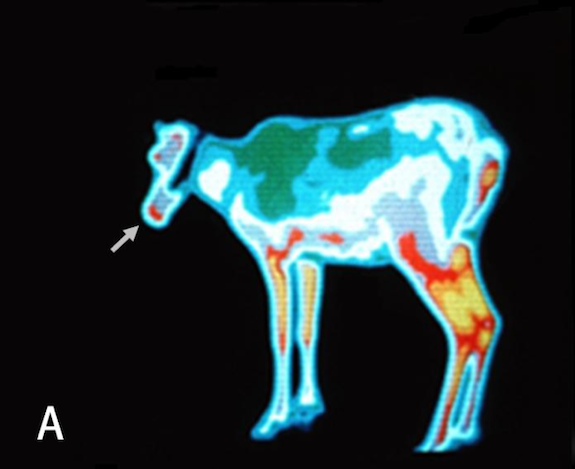
They also put the reindeer on a treadmill and used infrared imaging to measure what parts of their bodies shed the most heat after exercise. The nose, along with the hind legs, reached temperatures as high as 75°F—relatively hot for a reindeer—indicating that one of the main functions of all this blood flow is to help regulate temperature, bringing large volumes of blood close to the surface when the animals are overheated, so its heat can radiate out into the air.

In an infrared image, a reindeer’s nose (indicated by arrow) is shown to be especially red, a reflection of its temperature-regulating function. Image via Ince et. al.


Read more: http://blogs.smithsonianmag.com/science/2012/12/the-scientific-reason-why-reindeer-have-red-noses/#ixzz2GXo3bVaX 
Follow us: @SmithsonianMag on Twitter

sábado, 29 de diciembre de 2012

Are video games really the villains in our violent age?


Two Boys Playing Video Game
Video games can be force for good, despite what their detractors say. Photograph: Corbis RF/Alamy
The number of aliens you kill may directly contribute to an improvement in your brain. This may not sound like a typical scientific discovery, but it has come from some of the world's finest neuroscience laboratories. In fact, it is the genuine outcome of studies on how action video games can improve your attention, mental control and visual skills. We're talking here about fast-moving titles such as Halo, Call of Duty and Grand Theft Auto, which demand quick reflexes and instant decision-making. They're often portrayed as the most trashy, vapid and empty-headed forms of digital entertainment, but it looks as if they may be particularly good at sharpening your mental skills.
This may come as a surprise if you read much of the popular press, which is often obsessed with technological scare stories. Scientific evidence has been less media-friendly but considerably more convincing. We now have numerous studies on how playing action computer games, as opposed to puzzle or strategy titles such as The Sims or Tetris, leads to an improvement in how well we pay attention, how quickly we react, how sensitive we are to images and how accurately we sort information. Crucially, these studies are not just focused on people who already play a lot of video games, but are testing whether action video game training genuinely leads to improvements.
The studies use randomised controlled trials. It is a method normally used to test medications, but it can be applied to anything. In this case, a group of people are randomly assigned to one of two groups. Half get the "treatment", perhaps blasting away at enemy combatants in Medal of Honor, while the others get the "placebo" – for example, managing a digital family in The Sims 3. Reliably, those assigned to play the fast-moving action games show improvements on neuropsychological tests that measure the ability to process quickly and react to visual information. It's worth saying that these conclusions were thrown into doubt in 2011 when several scientists, led by Walter Boot from Florida State University, suggested that these findings may be due to poor experimental design, but subsequent and better planned studies have continued to find a positive effect.
Another aspect of the game debate concerns the impact of violent video games. This has become a matter of public anxiety again in light of the tragic Sandy Hook killings after the gunman was identified as being a fan of first-person shooter games such as Call of Duty. It's worth saying that such appalling events are not a good basis for science, simply because the popularity of this form of entertainment makes it difficult to attribute any form of link between their use and statistically rare individuals. This does not, however, mean that the issue itself is not important and worthy of study – and it has, in fact, been researched widely.
Also using randomised controlled trials, research has found that violent video games cause a reliable short-term increase in aggression during lab-based tests. However, this seems not to be something specific to computer games. Television and even violence in the news have been found to have a similar impact. The longer-term effects of aggressive gaming are still not well studied, but we would expect similar results from long-term studies of other violent media – again a small increase in aggressive thoughts and behaviour in the lab.
These, however, are not the same as actual violence. Psychologist Christopher Ferguson, based at the Texas A&M International University, has examined what predicts genuine violence committed by young people. It turns out that delinquent peers, depression and an abusive family environment account for actual violent incidents, while exposure to media violence seems to have only a minor and usually insignificant effect. This makes sense even in light of horrifying mass shootings. Several of the killers did play video games, but this doesn't distinguish them from millions of non-violent young men. Most, however, had a previous history of antisocial behaviour and a disturbed background, something known to be much more common in killers.
Perhaps the most telling effect of video games concerns not what they involve but how much time someone spends playing them. A helpful study on the effect of giving games consoles to young people found that, while the gaming had no negative impact on core abilities, school performance declined for those kids who put aside homework for screen entertainment. Similarly, a significant amount of research has found that putting aside exercise for the physical inactivity of video games raises the risk of obesity and general poor health.
And while "addiction" is now the pop psychology label of choice for anything that someone does to excess (sex, video games, shopping), the same behaviour could just as easily, and more parsimoniously, be described as a form of avoidant or unhelpful coping. Rather than dealing with uncomfortable life problems, some people avoid them by absorbing themselves in other activities, leading to an unhelpful cycle where the distractions end up maintaining the problems because they're never confronted. This can apply as easily to books as video games.
The verdict from the now considerable body of scientific research is not that video games are a new and ominous threat to society but that anything in excess will cause us problems. The somewhat prosaic conclusion is that moderation is key – whether you're killing aliens, racing cars or trying to place oddly shaped blocks that fall from the sky.
Vaughan Bell is a clinical and research psychologist based at King's College, London

Source: http://www.guardian.co.uk/technology/2012/dec/30/games-first-person-shooter-vaughan-bell

miércoles, 26 de diciembre de 2012

A Land Without Guns: How Japan Has Virtually Eliminated Shooting Deaths

japan july23 p.jpg
A Tokyo "gun" shop owner, who mostly sells air rifles, displays one of Japan's relatively few licensed rifles. (Reuters)

I've heard it said that, if you take a walk around Waikiki, it's only a matter of time until someone hands you a flyer of scantily clad women clutching handguns, overlaid with English and maybe Japanese text advertising one of the many local shooting ranges. The city's largest, the Royal Hawaiian Shooting Club, advertises instructors fluent in Japanese, which is also the default language of its website. For years, this peculiar Hawaiian industry has explicitly targeted Japanese tourists, drawing them away from beaches and resorts into shopping malls, to do things that are forbidden in their own country. 

Waikiki's Japanese-filled ranges are the sort of quirk you might find in any major tourist town, but they're also an intersection of two societies with wildly different approaches to guns and their role in society. Friday's horrific shooting at an Aurora, Colorado, movie theater has been a reminder that America's gun control laws are the loosest in the developed world and its rate of gun-related homicide is the highest. Of the world's 23 "rich" countries, the U.S. gun-related murder rate is almost 20 times that of the other 22. With almost one privately owned firearm per person, America's ownership rate is the highest in the world; tribal-conflict-torn Yemen is ranked second, with a rate about half of America's. 

But what about the country at the other end of the spectrum? What is the role of guns in Japan, the developed world's least firearm-filled nation and perhaps its strictest controller? In 2008, the U.S. had over 12 thousand firearm-related homicides. All of Japan experienced only 11, fewer than were killed at the Aurora shooting alone. And that was a big year: 2006 saw an astounding two, and when that number jumped to 22 in 2007, it became a national scandal. By comparison, also in 2008, 587 Americans were killed just by guns that had discharged accidentally. 

Almost no one in Japan owns a gun. Most kinds are illegal, with onerous restrictions on buying and maintaining the few that are allowed. Even the country's infamous, mafia-like Yakuza tend to forgoguns; the few exceptions tend to become big national news stories.

Japanese tourists who fire off a few rounds at the Royal Hawaiian Shooting Club would be breaking three separate laws back in Japan -- one for holding a handgun, one for possessing unlicensed bullets, and another violation for firing them -- the first of which alone is punishable by one to ten years in jail. Handguns are forbidden absolutely. Small-caliber rifles have been illegal to buy, sell, or transfer since 1971. Anyone who owned a rifle before then is allowed to keep it, but their heirs are required to turn it over to the police once the owner dies. 

The only guns that Japanese citizens can legally buy and use are shotguns and air rifles, and it's not easy to do. The process is detailed in David Kopel's landmark study on Japanese gun control, published in the 1993 Asia Pacific Law Review, still cited as current. (Kopel, no left-wing loony, is a member of the National Rifle Association and once wrote in National Review that looser gun control laws could have stopped Adolf Hitler.) 

To get a gun in Japan, first, you have to attend an all-day class and pass a written test, which are held only once per month. You also must take and pass a shooting range class. Then, head over to a hospital for a mental test and drug test (Japan is unusual in that potential gun owners must affirmatively prove their mental fitness), which you'll file with the police. Finally, pass a rigorous background check for any criminal record or association with criminal or extremist groups, and you will be the proud new owner of your shotgun or air rifle. Just don't forget to provide police with documentation on the specific location of the gun in your home, as well as the ammo, both of which must be locked and stored separately. And remember to have the police inspect the gun once per year and to re-take the class and exam every three years.

Even the most basic framework of Japan's approach to gun ownership is almost the polar opposite of America's. U.S. gun law begins with the second amendment's affirmation of the "right of the people to keep and bear arms" and narrows it down from there. Japanese law, however, starts with the 1958 act stating that "No person shall possess a firearm or firearms or a sword or swords," later adding a few exceptions. In other words, American law is designed to enshrine access to guns, while Japan starts with the premise of forbidding it. The history of that is complicated, but it's worth noting that U.S. gun law has its roots in resistance to British gun restrictions, whereas some academic literature links the Japanese law to the national campaign to forcibly disarm the samurai, which may partially explain why the 1958 mentions firearms and swords side-by-side.

Of course, Japan and the U.S. are separated by a number of cultural and historical difference much wider than their gun policies. Kopel explains that, for whatever reason, Japanese tend to be more tolerant of the broad search and seizure police powers necessary to enforce the ban. "Japanese, both criminals and ordinary citizens, are much more willing than their American counterparts to consent to searches and to answer questions from the police," he writes. But even the police did not carry firearms themselves until, in 1946, the American occupation authority ordered them to. Now, Japanese police receive more hours of training than their American counterparts, are forbidden from carrying off-duty, and invest hours in studying martial arts in part because they "are expected to use [firearms] in only the rarest of circumstances," according to Kopel.

The Japanese and American ways of thinking about crime, privacy, and police powers are so different -- and Japan is such a generally peaceful country -- that it's functionally impossible to fully isolate and compare the two gun control regiments. It's not much easier to balance the costs and benefits of Japan's unusual approach, which helps keep its murder rate at the second-lowest in the world, though at the cost of restrictions that Kopel calls a "police state," a worrying suggestion that it hands the government too much power over its citizens. After all, the U.S. constitution's second amendment is intended in part to maintain "the security of a free State" by ensuring that the government doesn't have a monopoly on force. Though it's worth considering another police state here: Tunisia, which had the lowest firearm ownership rate in the world (one gun per thousand citizens, compared to America's 890) when its people toppled a brutal, 24-year dictatorship and sparked the Arab Spring.


Source: http://www.theatlantic.com/international/archive/2012/07/a-land-without-guns-how-japan-has-virtually-eliminated-shooting-deaths/260189/

sábado, 22 de diciembre de 2012

A letter from a century ago


Tim Thorpe
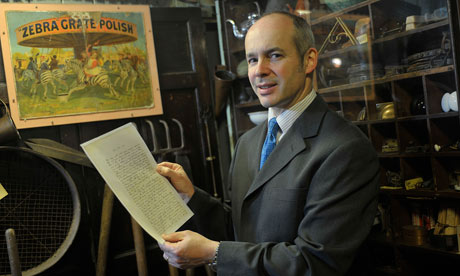
Tim Thorpe with the letter from his great-great-grandfather Guy Wood
For as long as Tim Thorpe can remember, he has known about the "12.12.12" letter. When he was a boy in the 1970s, his family would talk about his great-great-grandfather's ambitious message to people "belonging to me" 100 years into the future and, eventually, Thorpe received his own photocopy of the handwritten letter. The power of Guy Wood's message from beyond the grave, written on 12 December 1912, continues to fascinate his descendants, and for some, such as Thorpe, it sparked an interest in history that has shaped their lives and careers.
"This is the time of Flying Machines and Motor Cars only in their infancy. I often try to picture to myself what things will be like in 12.12.2012," wrote Wood, who was 51 and nearing the end of his working life as "head attendant" of an asylum. "I am writing this today to put on one side so that some of my offspring may perhaps read it."
Despite having little formal education, Wood read newspapers avidly and fearfully predicted the rise of Germany and the invention of "death dealing machines" that would kill people in their thousands. What he could not foresee was that his letter would become a treasured heirloom, and he would be delighted to know his words were still being read by his great-great-grandchildren when 12.12.2012 came to pass.
"It's written in a very dramatic way and gives an insight into the times in a very exciting way, and it really helped foster my interest in history," says Thorpe, 47, who is now collections officer at Lynn museum in Norfolk.
"This is the year of the greatest shipwreck ever known," wrote Wood of the sinking of the Titanic. "Said by the builders to be unsinkable owing to her watertight compartments, as she was sinking the Band played Nearer My God To Thee and then all was over."
Wood's letter next described how "a Great War is raging between the Balkan allies Bulgaria, Serbia, Montenegro, Greece against the Turks who have persecuted them for over 500 years". This turmoil was, of course, to resurface with the breakup of Yugoslavia some eight decades later.
Interestingly, while mass immigration was another anxiety of Edwardian times to be replayed today, Wood worried about the consequences of thousands of English people emigrating "every week to Canada, Australia and New Zealand", which led him to fear for the future of his country in 2012. "England I suppose will still be in existence although it looks sometimes as if we should be swallowed up by Germany or some other country the way they are spending money on warships, both for sea and air."
Wood's own views of the futility of war are clear. "It seems to me doctors are spending money and time in trying to cure and save life. Others are inventing guns and different kinds of death dealing machines to kill people by thousands all for greed and to conquer others," he wrote.
As Thorpe observes, the letter is reminiscent of HG Wells's The War of the Worlds, published 14 years earlier. Like Wells, Wood was a socialist and read the Daily Herald, a new daily paper for the working man. Nevertheless, it is strikingly unusual for someone to sit down and seriously consider a time 100 years from now, and write a letter to people not yet born, even in an era of great uncertainty when writers were creating the first science fiction. What compelled Wood to do so?
"He wanted some way of putting down his fears and anxieties on paper and the date came along. Did he do it out of a feeling of frustration at his powerlessness and his inability to change these great events?" says Thorpe. The letter reveals how historical events can affect the perceptions of an ordinary working person but it does not reveal much about Wood's personal life. And yet by writing his letter and reaching across the generations, he did something that any one of us could do, but don't – and marked himself out as a truly remarkable ancestor.
His descendants know relatively little about him, except that his life was scarred by bereavement. Born in Batley, Yorkshire, in 1861, Wood married Sophia, but four of their sons, who shared a bedroom, died of TB. After this tragedy, the family moved south and Wood got a job at Cane Hill asylum (latterly hospital) in Surrey. His daughter, Florence, survived, as did one son, Harry, who left school at 11 and became a "hall boy" at Cane Hill. It appears his parents continued to worry that he too would succumb to TB, and he was encouraged to work in warmer climes, on a cruise ship – where he played the violin – when he was 17. Later, Harry became the first Labour county councillor in Essex.
Does Thorpe wish his great-great-grandfather had written more personally about his family? "He probably didn't see that as important – he's not boasting about his own life," he says. "In many ways it is personal, in that his hopes and fears are expressed very well." In fact, Wood lived to see the logical conclusion of many of the trends he identified in 1912. After his wife died, Wood decided he would be looked after by his son Harry and his family. "My nanny remembers him arriving at her front door complete with a huge box of piano and violin music, and he said, 'You're going to look after me now,'" says Thorpe.
His mother, Daphne, recalls that, when she was a child in the 40s, Wood wore a smoking jacket and a fez, and lived in glorious isolation in her grandfather's front room, where he took his meals and smoked his pipe. Before lunch and dinner, Daphne would be told to go and speak to her great-grandfather. "She would have a quick chat with him before he took his lunch," says Thorpe. "I think he was quite a grumpy old man by then – he was in his 80s," says Thorpe. Wood died in 1946, aged 85.
Wood's letter demonstrates the transformations of a century, but also shows the great constant of human nature and our unchanging hopes and fears. His observations also prove how difficult it is to know what is to come. Votes for women is a "great rage" he observed, in which "100s of women congregate together and smash windows and other kinds of outrageous deeds on purpose." With hindsight, the political emancipation of women seems inevitable, but Wood's verdict – "I don't know if they will get votes or not" – shows it was far from a foregone conclusion at the time. Thorpe first read Wood's letter when he was a child. "In the 70s, when we imagined 2012 we thought of an Arthur C Clarke world of space exploration and science fiction."
Thorpe knows of no other family mementoes of his great-great-grandfather except one photograph, but Wood's fascination with the future, and the window he created into the past, has had an enduring legacy. Daphne became a history teacher and Thorpe says the letter inspired his fascination with modern history, which he studied at university before choosing a career working in museums.
Thorpe is certain that his great-great-grandfather's letter will survive for another 100 years, and he and his two brothers will pass it on to their children. Has Thorpe considered writing his own updated version? "Where do you start? How do you imagine what life is going to be like 100 years from now?" he says.
"It's fascinating to have this direct line of communication from him, otherwise he'd just be a name on a census list. Now he'll always be thought of as a real living human being who was very thoughtful and caring and sent us this direct line from the past. I'm so grateful. We feel it's a real gift to us, his great-great grandchildren. It's such a magical message to receive."
• This article was updated on 22 December 2012 to include an image of Tim Thorpe with the letter from his great-great-grandfather Guy Wood

Source: http://www.guardian.co.uk/lifeandstyle/2012/dec/22/letter-from-a-century-ago

El Gordo jackpot brings joy and austerity relief to thousands in Spain


El Gordo
Lucky number: celebrations in Grañén, north Spain, after the traditional Christmas Gordo lottery. Photograph: Jose Jordan/AFP
Spaniards facing yet another year of economic misery found relief in the world's biggest lottery payout on Saturday, the traditional Christmas Gordo, or Fat One, which spread €2bn in prize money around the country.
Champagne corks popped in towns, cities and villages across Spain as tens of thousands of winners took home enough money to keep their families going through the dark days of 2013 and beyond.
"Yesterday we were both on the dole, but today we are winners," said one happy couple who danced in front of television cameras in Alcalá de Henares, a university town 20 miles from Madrid, after collecting €400,000.
That was the prize handed out to each of the 1,800 people who bought shares known as décimos – priced at €20 each – in the winning lottery number. Most lived in a working-class neighbourhood of the town though the winning number 76058 was sold in 40 places around the country.
One family walked away with €4m after Antonio Ortega Sánchez bought a total of 10 winning décimos and gave them away to his children and siblings. "My dad, brother and uncle have all got tickets as well," said his daughter. "I'll be buying a decent house and a car."
First held in 1812, the Christmas lottery has become a tradition with Spaniards spending an average of more than €70 a head on it. That amounts to almost €3bn, with around two-thirds handed back in prizes that vary from 20,000 times the original bet to simply getting money back.
The rest is held on to by the state lottery fund to cover costs and boost Spain's exchequer – with sales income from the Gordo reducing the country's deficit by the equivalent of 0.1% of GDP. Spaniards are glued to television sets, radio and the internet every 22 December as the lottery numbers are picked out at a Madrid theatre by schoolchildren.
This year, however, the event was interrupted by workers from the publicly owned Madrid regional television station Telemadrid – where some 900 people face the sack in 2013. Other protesters at the event complained about the health cuts that form part of prime minister Mariano Rajoy's austerity measures as Spain struggles with recession, 26% unemployment and fast-growing debt.
This is the last year that Gordo winners can enjoy their money tax-free. The government is imposing a new tax on winnings of more than €2,000 next year. It has also tried to privatise the state lottery – which holds weekly draws but earns half of its income on the Gordo – but eventually decided it could generate more income by keeping it in public hands.
Superstitious Spaniards had this year sought numbers coinciding with everything from the supposed Mayan date for the end of the world to the day on which an elderly, amateur art restorer called Cecilia Jiménez became world famous with her botched restoration of the Ecce Homo painting at a church in Borja, central Spain.

Source: http://www.guardian.co.uk/world/2012/dec/22/el-gordo-jackpot-spain

jueves, 20 de diciembre de 2012

Walking in The Air


Before Robert Zemeckis "Polar Express" there was everyone's favorite heart warming animated adventure "The Snowman" (1982) about a young English boy who makes a snowman one Christmas Eve, only for it to come to life that night and take him on a magical adventure to the North Pole to meet Santa Claus. 
The title comes from an animated cartoon, which is shown on TV every Christmas day in Britain and has become something of a tradition in the manner of the Queen's Christmas Day Speech to the Nation. Maybe the cartoon has been shown in the USA - I don't know? It's about a little redheaded boy who builds a snowman on his front lawn. Like most young children he's very reluctant to leave the snowman when his mother calls him in after dark. At midnight on Christmas Eve he peeps from his window and finds that the snowman he built that day has magically come to life. He then runs downstairs and dances with the snowman. 

The Snowman takes him on his back on a magical journey, flying across many countries to the North Pole where every Christmas Eve there's a convention of snow people from all lands. They wing their way together to an icy landscape where they meet Father Christmas. There's much dancing and jollity. Eventually the tired out little boy flies back home to England on the snowman's back and goes back to bed. The snowman resumes his position in the garden.

Upon awakening next morning, the little boy rushes to his bedroom window to see his friend. Alas, you've already guessed the sight that meets his eyes. The sun has melted the snowman all away. All that remains is his hat and carrot nose. I always cry at this point, no doubt with millions of others. The soundtrack music is hauntingly beautiful.

Raymond Briggs' picture book is irresistibly brought to life in this wordless, animated tale. Probably best known for the soundtrack (which features "Walking in the Air" sung by Aled Jones) this charming film avoids the over-sentimentality which could have spoilt it and touches the heart in a delightful way. The music perfectly complements the animation, especially during the flying scenes, where the landscape unfolds in rolling images like waves. This is animation for all ages and nationalities, not only because it has no dialogue, but also because it carries an underlying message about life and love - and it also features a great old-fashioned Father Christmas.
The content of the film is poignant and has a bittersweet ending which could be upsetting to some young children. In this capacity it is more of an adult film than a children's animation, as adults have the ability to look back and understand what the film is saying and what it says about our own lost childhoods. But for children it will simply be a magical tale of excitement and friendship. In a day and age where most children's entertainment seems to revolve around violence, this is a truly charming and heartwarming short film.


We're walking in the air
We're floating in the moonlit sky
The people far below are sleeping as we fly
I'm holding very tight
I'm riding in the midnight blue
I'm finding I can fly so high above with you
Far across the world
The villages go by like dreams
The rivers and the hills, the forests and the streams
Children gaze open mouthed
Taken by surprise
Nobody down below believes their eyes
We're surfing in the air
We're swimming in the frozen sky
We're drifting over icy mountains floating by
Suddenly swooping low
On an ocean deep
Rousing up a mighty monster from his sleep
And walking in the air
We're dancing in the midnight sky
And everyone who sees us greets us as we fly
We're walking in the air


Source: http://www.youtube.com/watch?v=31mjvrydaLM

miércoles, 12 de diciembre de 2012

The Hobbit: An Unexpected Journey Review


The Hobbit: An Unexpected Journey
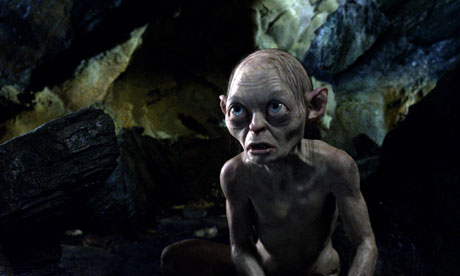
The Hobbit: An Unexpected Journey sees many actors from the Ring trilogy return, including Andy Serkis as Gollum. Photograph: Warner Bros/AP

"Unexpected" is right, for a couple of reasons. Peter Jackson, the man who brought Lord Of The Rings to the big screen to eardrum-shattering acclaim 10 years ago, is now taking just the same approach to Tolkien's much slighter, slimmer children's book The Hobbit. It's getting expanded into three movie episodes of which this whoppingly long film is the opener.

The second unexpected point is the look of the thing. Jackson has pioneeringly shot The Hobbit in HFR, or High Frame Rate: 48 frames a second, as opposed to the traditional 24, giving a much higher definition and smoother "movement" effect. But it looks uncomfortably like telly, albeit telly shot with impossibly high production values and in immersive 3D. Before you grow accustomed to this, it feels as if there has been a terrible mistake in the projection room and they are showing us the video location report from the DVD "making of" featurette, rather than the actual film.
So Tolkien's gentle tale is going to be a triple box-office bonanza, occupying the same amount of space as the mighty Rings epic, an effect achieved by pumping up the confrontations, opening out the backstory and amplifying the ambient details, like zooming in on a Google Middle Earth.


There can be no doubt that Jackson has made The Hobbit with brio and fun, and Martin Freeman is just right as Bilbo Baggins: he plays it with understatement and charm. But I had the weird, residual sense that I was watching an exceptionally expensive, imaginative and starry BBC Television drama production, the sort that goes out on Christmas Day, with 10 pages of coverage in the seasonal Radio Times, and perhaps a break in the middle for the Queen's Speech.
Well, it grows on you. The HFR style has immediacy and glitter, particularly in the outdoor locations, where the New Zealand landscapes, in all their splendour, are revealed more sharply and clearly, and there is an almost documentary realism to the fable. Indoors though, it's not quite the same story.
We approach the drama via its mythic setup: the terrifying dragon Smaug appropriates the Dwarf Kingdom of Erebor. The older hobbit, played with maundering geniality by Ian Holm is presented to us; then it's back in time to meet our unlikely hero, the gentle Bilbo Baggins, younger but still a somewhat donnish, bookish bachelor figure like Tolkien and CS Lewis. He is contacted by the charismatic Wizard Gandalf The Grey — and it's a pleasure to see Ian McKellen back in the cloak, whiskers and pointy hat, bringing a sparkle of life and fun to the part, and stealing the scene with ruminative little smiles and eyebrow-raisings.
Under Gandalf's influence, Bilbo is forced to confront his destiny as a hobbit of action, and acquaints himself with the robust warrior class of dwarves. There's a nice performance from Ken Stott as Balin, with an outrageous big purple-ish nose, as if he's spent his time in exile drinking malt whisky. They are led by the mighty and taller warrior Thorin, played by Richard Armitage.
And so the quest begins, and the questers come across such familiar figures as Galadriel – a seraphic and almost immobile Cate Blanchett – and Saruman, played with impassive dignity and presence, of course, by Christopher Lee. But soon they must tackle the evil Orcs.
There are explosively dramatic battles, with a lot of 3D plunging from vertiginous heights. But the crux comes with Bilbo's meeting with the ineffably creepy Gollum, played in motion-capture once again by Andy Serkis. It is a terrific scene, a contest of nerves, a duel of wits, and the one moment in the film where the drama really comes alive and Freeman's (admirable) underplaying of the role works well against Serkis's animal paranoia.
There is also something quietly affecting in Gandalf's moral strategy in recruiting Bilbo: "I found it is the small things, everyday deeds of ordinary folk, that keeps the darkness at bay. Simple acts of kindness and love. Why Bilbo Baggins? Perhaps it is because I'm afraid, and he gives me courage."
And the rest of the film offers an enormous amount of fun, energy and a bold sense of purpose. But after 170 minutes I felt that I had had enough of a pretty good thing. The trilogy will test the stamina of the non-believers, and many might feel, in their secret heart of hearts, that the traditional filmic look of Lord of the Rings was better. But if anyone can make us love the new epically supercharged HFR Hobbit, it's Peter Jackson.

Source: http://www.guardian.co.uk/film/2012/dec/09/hobbit-an-unexpected-journey-review